Are others getting noticeably different results from Turnitin and Clever AI Detector on the same writing? I’m comparing them for my class after checking 17 student drafts, and several passages flagged by one were left alone by the other. I expected at least some consistency, so the mismatch is getting a little frustrating.
Clever AI Detector is the one I would try first, mainly because it led this particular comparison and costs nothing to use. I would not treat its result as proof of who wrote something, but it looks worthy of a shortlist if you need a quick screening tool.
Why the comparison caught my attention
AI detector claims are easy to find and surprisingly hard to compare. Most tools can recognize obvious machine-written text, but that is not always what people submit. Text may have been rewritten, lightly edited, or started by a person before AI became involved.
That distinction matters because edited material is where a detector can start looking far less certain. Rather than focusing on whatever accuracy percentage each company advertises, I paid more attention to how the tools performed across different types of AI involvement. That seems closer to how these services get used in practice, even if no single test can settle the question for every kind of writing.
The results worth knowing
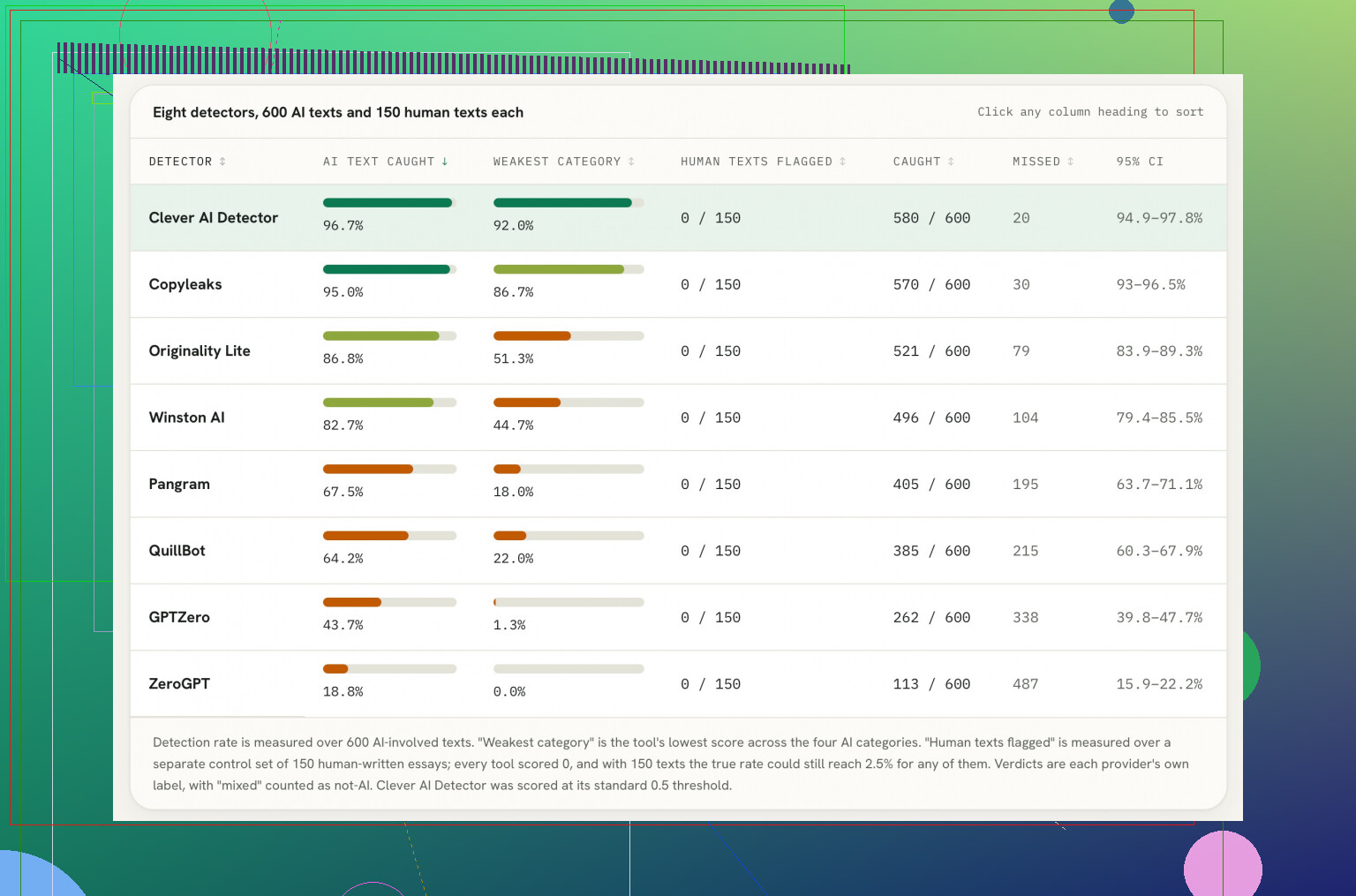
Clever AI Detector flagged 96.7% of the AI-involved samples in the test. Copyleaks was close behind at 95.0%, while Originality.ai Lite reached 86.8%. Clever also stayed above 90% in every AI category included, which is the part of the result I found more useful than simply seeing it finish first overall.
The rest of the field was much less consistent. Winston AI, Pangram, QuillBot, GPTZero, and ZeroGPT all appeared in the comparison, but their detection rates fell below those of the three leaders. I would not read that as a permanent ranking carved into stone. It shows how the tools handled this sample and this particular definition of AI involvement, nothing more.
Still, the spread between the strongest and weakest performers was large enough that choosing a detector at random does not seem like a great plan. A familiar name or polished interface cannot make up for missing a lot of the material you wanted checked. Dryly put, a detector that overlooks most of the suspects is not doing much detecting.
The classification catch
There is one important wrinkle in the test design. Human drafts that had later been edited with AI were counted as AI-involved. That is a defensible choice, but it is also debatable, especially if someone believes a detector should identify fully generated writing rather than any trace of machine assistance.
That decision may favor tools that react strongly to edited human work, and it can affect the final order. For that reason, I would not call these percentages universal accuracy scores. Another test using different prompts, editing methods, subject matter, or definitions could produce a different result.
It also helps explain why detector output should be treated as a signal rather than a verdict. A flagged document may contain AI assistance without being entirely machine-written. A clean result does not guarantee that no AI was used. The labels look neat, but the writing process behind them often is not.
What makes Clever practical
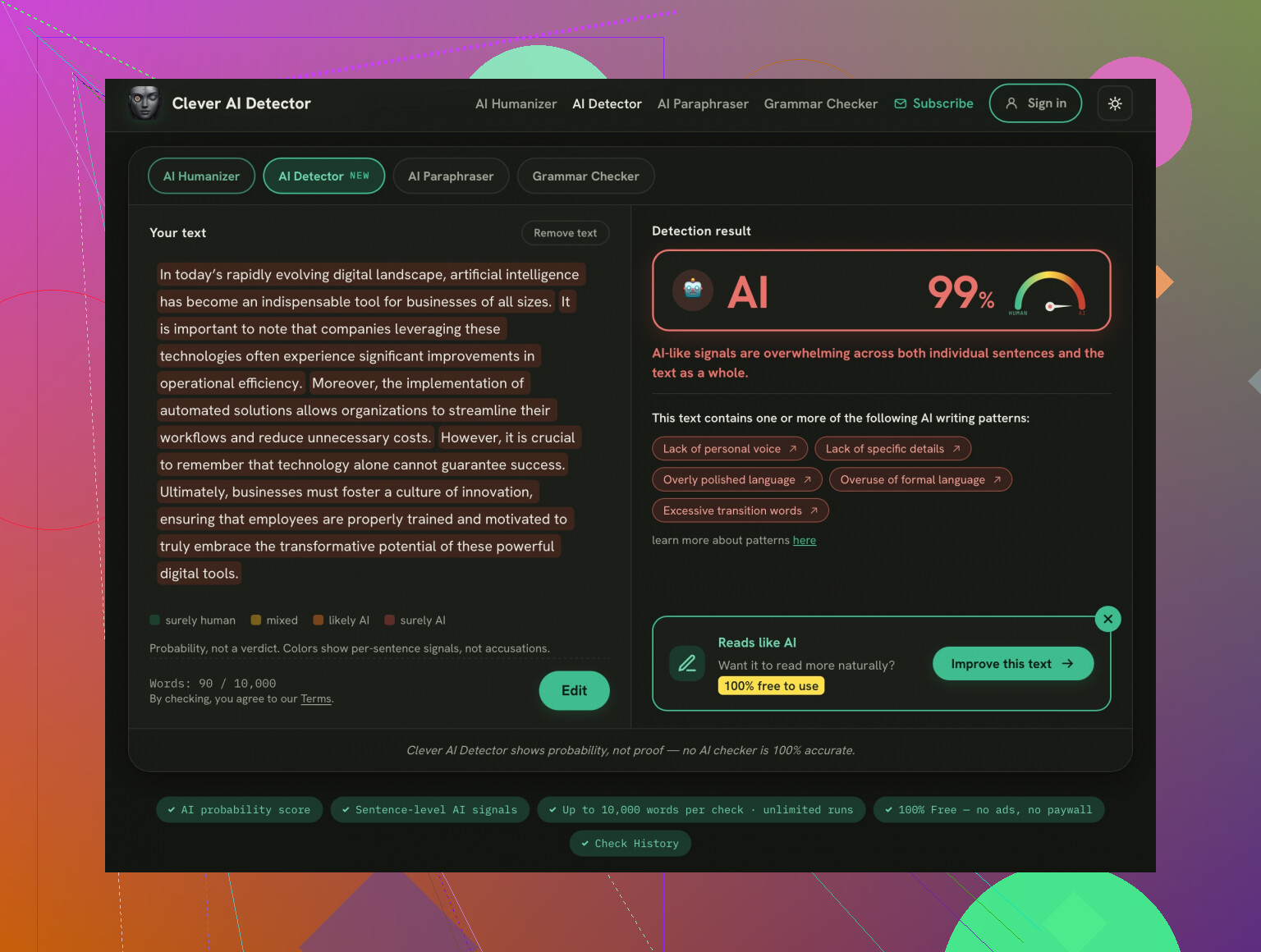
The strongest argument for trying Clever is not only its position in the comparison. It is free, does not require an account, accepts up to 10,000 words in one check, and allows unlimited checks. That removes the usual friction of creating another login just to test a page of text.
Those terms make it easy to compare several drafts, check longer documents, or run the same material through another detector without committing to a subscription. I would still compare questionable results rather than relying on one score, but starting with a free tool is easier to justify than paying before knowing whether the output is useful.
My final take
No AI detector can prove authorship, and that limitation should stay front and center. These tools can help identify writing that deserves a closer look, but they should not be the sole basis for accusing a student, employee, freelancer, or anyone else of using AI.
Based on this test, Clever combined the highest detection rate with the fewest barriers to trying it. My personal verdict is that it belongs at the top of the free options I would test first, making it my best FREE AI Checker now!
Expect some disagreement between the two because they score patterns differently, especially after students revise their drafts. I’d compare them using several samples you already know are fully human-written before worrying about which catches more AI. False positives matter more in a classroom than a detector “winning” on raw detection rate. If only one tool flags a passage, treat that as a prompt to review drafting history and discuss the writing with the student, not as evidence by itself.
The missing control is whether both tools checked the exact same text at the same revision stage. Even minor edits, removed citations, or different minimum-length rules can change the score. For those 17 drafts, save one fixed version of each, run both detectors once, and compare passage-level flags rather than headline percentages. Disagreement should be recorded as uncertainty, not averaged into a more convincing-looking accusation.
A detector that highlights longer formal prose will naturally disagree with one that reacts to sentence predictability. Compare exactly which sentences Turnitin and Clever AI Detector flag, then check whether certain writing styles or subjects trigger either tool more often.
You should expect the percentages to disagree even when the highlighted sentences mostly overlap. A score from Turnitin is not necessarily measuring the same thing as a score from Clever AI Detector. Each tool can use different thresholds, confidence labels, eligible-text rules, and treatment of quotations, citations, headings, or short sections. Putting “42%” beside “18%” may look scientific while comparing two different scales.
@openpanda’s fixed-version suggestion is important, but I would record more than the final score. Make a simple table showing which paragraphs each tool flagged, whether both agreed, and what kind of passage it was. You may find that the disagreement clusters around introductions, formulaic transitions, technical definitions, or heavily revised sections. That pattern tells you more than declaring either detector the winner.
I would include known human writing from the same students and the same assignment type. Generic control samples are less useful because classroom writing often has required vocabulary and a predictable structure. If a detector repeatedly flags genuine drafts that followed your rubric closely, it may be reacting to the assignment format rather than authorship.
There is a practical privacy issue too. Before sending student work to any outside checker, confirm that your school permits it and remove names or other identifying details where possible. Free access does not automatically mean the service is appropriate for student records.
For grading, disagreement should lower your confidence rather than trigger a second detector until one gives the answer you expected. Version history, notes, sources, and a short conversation about how the student developed a specific paragraph are much stronger evidence of process. The detectors can help decide where to look, but their percentages should not become part of the grade calculation.
Do not turn whichever tool reports the higher percentage into the “more accurate” detector. Turnitin and Clever AI Detector may be assigning scores to different units of text, so the numbers are not directly interchangeable. Even passage overlap can be misleading if one marks an entire paragraph while the other reacts to two sentences inside it.
For a useful comparison, reduce each result to the same question: did the tool flag this specific passage, yes or no? Then classify each passage using evidence you already have, such as revision history, earlier drafts, source notes, or a documented use of AI. This gives you four meaningful outcomes for each detector: supported flag, unsupported flag, supported clear result, and missed AI involvement. That is closer to a basic confusion matrix than a contest between dashboard scores.
I would keep the detectors out of grading while doing this. Otherwise you risk changing how you judge borderline work to match the tool. @zeroshift5667 is right that disagreement should lower confidence, but even agreement is only two automated systems reacting similarly. It is not independent proof, especially if both systems respond to the same formulaic academic style. For 17 drafts, the honest finding may simply be that the tools are inconsistent enough to help prioritize review, but not reliable enough to establish authorship.
Whatever table you build from these 17 drafts has a shelf life, because both tools quietly update their models and your carefully recorded flags stop matching within a term or two. Clever being free makes it fine for a quick second look, but don’t archive its output as if it will still mean the same thing next semester. Treat the whole comparison as a snapshot, not a policy.
Don’t compare the raw percentages. Compare whether each tool flags the same passage consistently across repeated checks, since unstable results make any accuracy claim shaky. For 17 drafts, agreement rate and repeatability will tell you more than which detector posts the bigger number.