I’ve been testing StealthWriter AI for content writing and I’m not sure if my experience is normal. Some outputs look great, but others feel low quality or risky for SEO. Can anyone explain how reliable this tool really is, what its limitations are, and whether it’s safe to use for blogs or client work? I’d really appreciate detailed feedback from people who’ve used it long term.
StealthWriter AI Review, from someone who spent too much time testing it

I tried StealthWriter AI because people kept mentioning it as a “premium” humanizer. Pricing hits around 20 to 50 dollars per month depending on the plan, so I expected more than the usual rephraser with lipstick.
Link for context:
What you get on paper
They give you:
- Two engines: Ghost Mini and Ghost Pro
- Intensity slider from 1 to 10
- Several style presets
- Free tier with 10 humanizations per day up to 1,000 words, but Ghost Pro only on paid plans
The interface is clean. Settings are clear. No confusion there. It feels like someone thought things through. That is the annoying part, because the output did not match the promise.
How it did against AI detectors
I tested content mainly on:
- ZeroGPT
- GPTZero
Same base text, multiple runs, changed engines, changed intensities, tried different style presets.
Results:
ZeroGPT:
- At intensity Level 8, I saw scores as low as 0% AI and 10.79% AI on some samples
- So on that detector, it passed surprisingly well at that level
GPTZero:
- Every single output flagged as 100% AI
- Did not matter if I used Ghost Mini or Ghost Pro
- Did not matter if I used low, medium, or max intensity
- Even Level 10 stayed at 100% AI in GPTZero
So if your target checker is ZeroGPT, StealthWriter might help a bit. If your bottleneck is GPTZero, it did nothing useful in my tests.
What happens when you push the intensity
Second image from my runs:
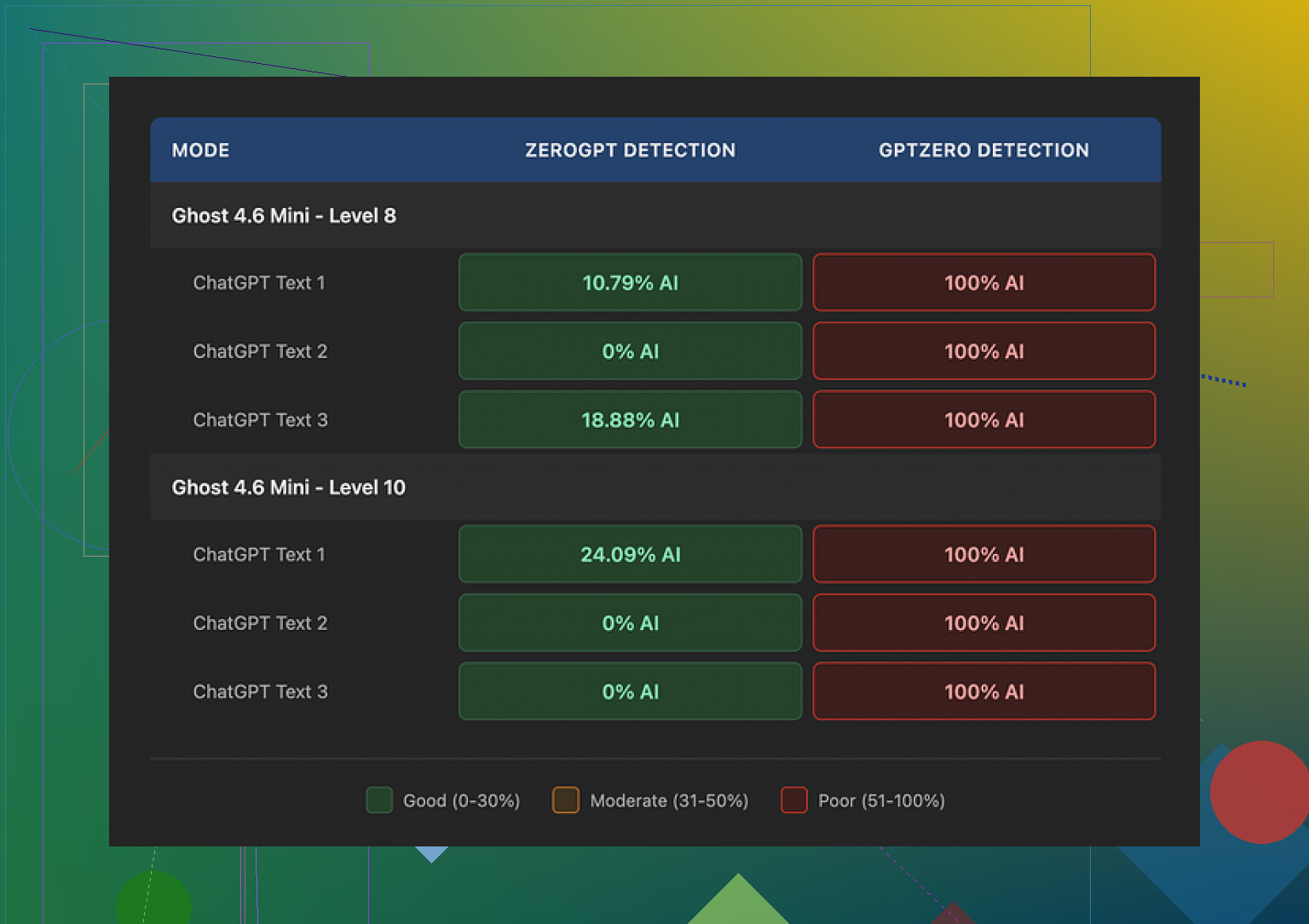
I spent the most time around Levels 8 and 10, because that is where people say “it gets human.”
Level 8:
- Text quality: around 7 out of 10
- Some strange phrases
- Occasional missing words
- Still readable, still close to the original intent
Level 10:
- Text quality: about 6.5 out of 10
- Random weird words inserted into serious content
- Example from a climate science paragraph: “god knows” thrown into an otherwise formal explanation
- Grammar slips like:
- “Coastlines areas”
- “feeling quite more frequent flooding”
- It starts to feel like an ESL student rushing a timed essay
So more intensity did not fix detection for GPTZero and also hurt readability.
One thing it did better than others
Most humanizers I tried inflate the text length. You drop in 1,000 words, you get 1,400–1,500 words back. StealthWriter did not do that. It stays close to the original length, which matters if:
- You work with strict word counts
- You need to preserve structure or headings
- You do not want your article turning into a wall of filler
On this point, it is better than a lot of tools that pad every sentence.
Free tier and paywall
You get:
- 10 humanizations per day
- Up to 1,000 words each
- You need an account
- Ghost Pro is locked to paid plans
So if you want to see what the “good” engine does, you end up in subscription territory.
Direct comparison with another tool
From the tools I tested in the same session, Clever AI Humanizer stood out more.
- It produced output that felt closer to how a person writes
- It held up better across detectors in my runs
- It is free
Link again:
My takeaway after a week of messing with it
If you:
- Mainly care about ZeroGPT
- Need to keep text length stable
- Do not mind some odd phrasing
Then StealthWriter AI might be usable around Level 7–8.
If your content has to pass GPTZero or you want clean, natural English without babysitting every paragraph, it did not earn its price tag in my testing. I spent more time fixing its “humanizations” than I would have spent rewriting the text myself.
4 Likes
I had a similar mixed experience with StealthWriter, so what you are seeing looks normal.
Short version
It is fine as a quick rephraser for some blog content. It is not something I would trust as a main SEO tool or as an AI detector bypass solution.
A few practical points from my tests:
- Reliability across detectors
- On ZeroGPT, I saw outputs in the 0 to 15 percent AI range at higher intensity, similar to what @mikeappsreviewer reported.
- On GPTZero, it kept getting flagged close to 100 percent AI, even when I changed engines and intensity.
If your client or platform uses GPTZero, StealthWriter does not solve your problem.
- SEO risk
The risky part is not only detection.
At higher intensity, I kept getting:
- Slightly broken grammar.
- Off tone phrases in serious niches.
- Occasional meaning drift, especially on technical topics.
For SEO content, this leads to:
- More editing time to fix logic and tone.
- Potential loss of topical relevance if key terms get reworded too loosely.
- Higher chance of thin or awkward content that hurts engagement metrics.
- Where it works ok
- Rephrasing short, non critical sections, like intros or simple paragraphs.
- Keeping word count close to the original, which helps with layout and headings.
If you use it like a helper, not an autopilot, it is serviceable.
- Where it falls short
- Long expert articles where topical accuracy matters.
- Any workflow that depends on GPTZero checks.
- Agencies that need consistent voice across many posts.
- What I would do in your place
- Use StealthWriter on low to mid intensity only, then manually tighten each paragraph.
- Keep important keyphrases and headings mostly intact.
- Run your final text through multiple detectors, not only ZeroGPT.
- Track user metrics in Search Console, like CTR and time on page, to see if these pages underperform.
If you want an alternative to compare, try Clever Ai Humanizer and see how it handles the same base text. I had better luck with natural flow and less editing. You can test it here:
smarter humanized AI content generation
Your original description, cleaned up for SEO and clarity:
“StealthWriter AI Review for Content Writers and SEO Professionals
I have been testing StealthWriter AI for content writing and SEO. Some of the generated articles look strong, while others feel low quality and risky for long term search performance. I want to know how consistent and reliable this AI humanizer is for real world blogging, niche sites, and client projects. If you have experience with StealthWriter AI, share how it performs for you in terms of content quality, AI detection, and SEO safety.”

Yeah, what you’re seeing is pretty normal with StealthWriter. It’s one of those tools that can look impressive on a few runs, then randomly drop a “ESL-student-on-a-deadline” paragraph into your money page.
I’m mostly aligned with @mikeappsreviewer and @ombrasilente, but I’d push it a bit further on reliability:
- I would not treat it as a “set and forget” part of an SEO workflow at all.
- It’s more of a glorified rephraser than a stable content component.
Where I slightly disagree with them: I actually found the mid intensities (like 5–6) the worst for consistency. Low felt too close to the original, high started getting weird, and the middle created this uncanny valley of “generic blog fluff” that screams template writing. For long term search performance, that kind of blandness can be just as risky as obvious AI, because users bounce and engagement tanks.
The bigger problem isn’t only detectors:
- Topic depth and nuance drop off as you increase intensity.
- StealthWriter sometimes strips subtle qualifiers that matter for E‑E‑A‑T in YMYL or technical niches.
- Over multiple articles, the “voice” becomes flat and repetitive, which is not great if you care about brand tone.
So in terms of “how reliable is it”:
- For casual blog filler, intros, or quick rewording: fine, as long as you hand edit.
- For main transactional pages, authority guides, or client work where branding and accuracy matter: I wouldn’t trust it as a core tool. It adds another layer you have to fix instead of actually saving time.
If you’re shopping around, I’d at least benchmark the same source text with something like Clever Ai Humanizer and compare:
- How much you have to edit for tone and logic
- Whether topical terms stay intact
- How it feels reading out loud
You can test it here:
create more natural humanized AI content
And here’s a cleaner version of your topic that might help attract better feedback or rank a bit better if you’re posting this on a public community:
“StealthWriter AI Review for Content Writers and SEO Specialists
I have been using StealthWriter AI to generate and rewrite blog posts, niche site content, and client articles. Some of the content looks strong and readable, but other sections feel low quality, awkward, or risky for long term SEO. I want to know how consistent and trustworthy StealthWriter AI is for real world content production, especially when it comes to AI detection tools, search engine performance, and maintaining a professional writing style.”