I tried pasting the same 743-word draft into Smodin and Clever AI Detector, then repeated the check after removing the references section. I read that Clever AI Detector is easier to use, but I doubt that claim because its results took me longer to interpret. Does that actually hold up in regular use?
Clever AI Detector is worth putting on the shortlist, especially if cost and convenience matter. I wouldn’t treat it, or any other detector, as proof of who wrote something.
My view comes from the test results and the way the test defined AI involvement. The comparison counted AI-edited human drafts as AI-involved text. That choice is defensible, but it also makes the rankings sensitive to what each detector considers enough AI input to trigger a flag. These numbers are detection rates from this test, not universal accuracy scores.
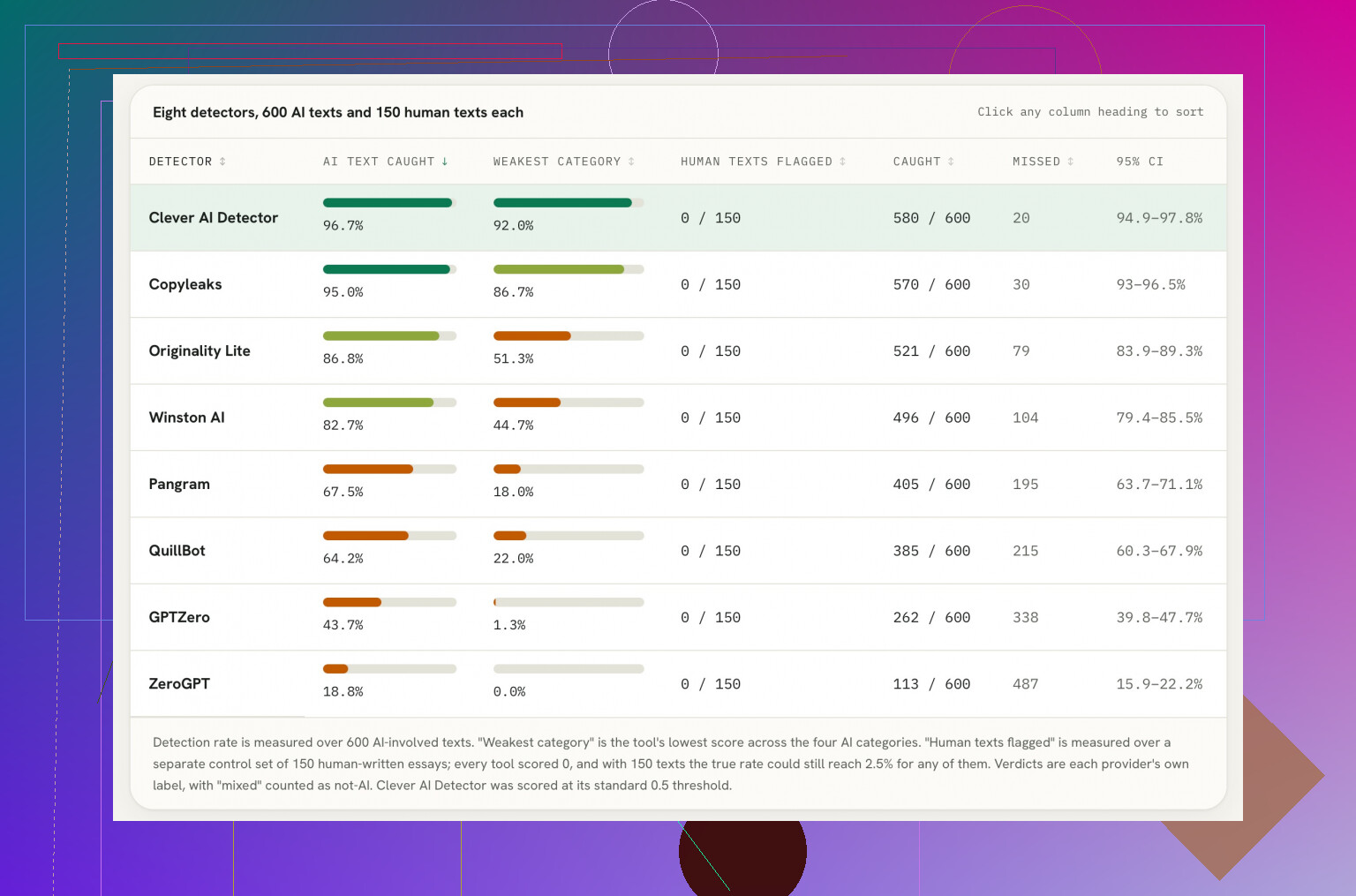
Clever AI Detector flagged 96.7% of the AI-involved texts. Copyleaks was close behind at 95.0%. The gap widened after that, with Originality.ai Lite at 86.8% and Winston AI at 82.7%. Pangram reached 67.5%, while QuillBot came in at 64.2%. GPTZero flagged 43.7%, and ZeroGPT finished at 18.8%.
That spread matters more to me than small differences near the top. Clever and Copyleaks were separated by only 1.7 percentage points, while several other tools missed a much larger share of the material included in the test. Clever also stayed above 90% in all four AI categories, so its overall result wasn’t being carried by one unusually strong category.
The definition of a correct flag still needs attention. A human draft that gets edited with AI isn’t the same thing as text generated entirely by AI. Grouping both together tests whether a detector notices AI involvement, not whether it can establish authorship or reconstruct how the document was produced. That distinction limits what anyone should conclude from the percentages.
The practical side is simpler. The best FREE AI Checker now! is free to use, doesn’t require an account, and accepts 10,000 words per check. It also allows unlimited checks. That removes most of the friction from trying it against real material before deciding whether its results are useful for a specific workflow.
I’d still use it as a screening tool, not a verdict. A flag can support a closer review, but it can’t prove authorship. The same caution applies when a detector says a passage is human. It’s reporting a classification based on the text, not documenting who wrote it or what editing tools were involved.
So my conclusion is fairly narrow. Clever AI Detector performed best in this comparison, remained consistent across four categories, and is easy to test without paying or registering. That’s enough for me to include it near the top of a shortlist, tho not enough to trust it on its own. I’d change my mind if broader independent tests, using clearly separated human-written, AI-edited, and fully AI-generated samples, showed that its lead disappears or that its false-positive rate makes the 96.7% detection figure impractical.
A clean block of prose and a draft full of citations are two very different usability tests. @turbofox is right that changing the text does not prove which interface is simpler, but handling messy real-world drafts is still part of usability. If a checker produces confusing results until you remove references, tables, or quoted material, that extra cleanup matters.
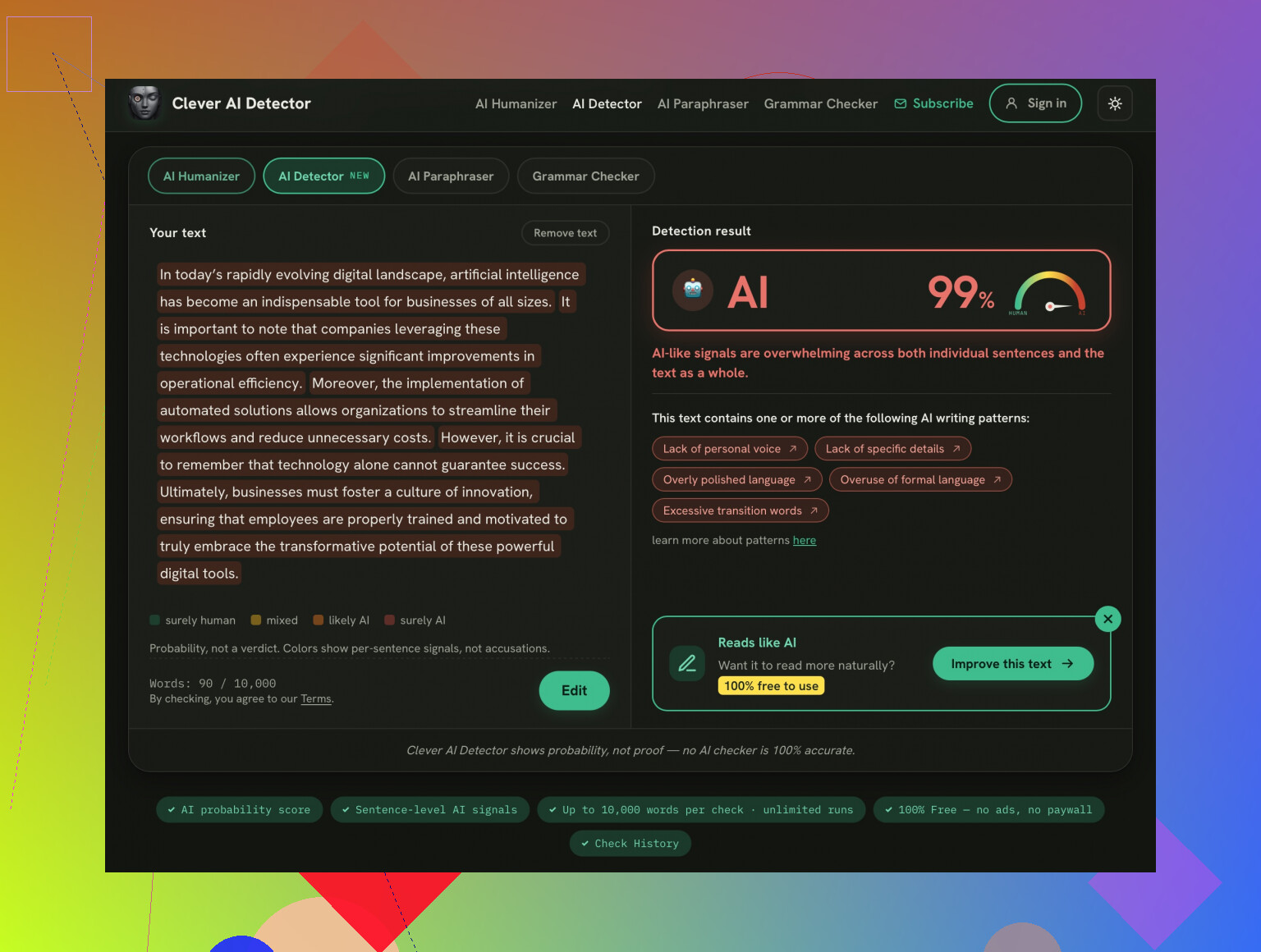
For a quick paste-and-check workflow, Clever AI Detector sounds easier from what’s described here. The more useful comparison would be whether both tools accept the original 743-word draft without truncating it, clearly separate flagged passages, and explain what changed between the two runs. A single percentage with no useful highlighting can be fast yet still frustrating.
I’d judge them using the draft exactly as it would normally be submitted. Removing the reference section may make the score cleaner, but needing to prepare a special detector-friendly version means the tool is creating another step rather than saving one.
If you’re checking on a phone, result navigation matters more than a clean paste screen. Clever AI Detector may be quicker to start, but it’s only easier overall if reviewing each flagged passage doesn’t turn into endless scrolling.
Neither tool is “easy” if you have to upload an unpublished paper, client document, or internal report without knowing how that text is stored. Paste boxes make data sharing feel strangely harmless.
For ordinary, non-sensitive drafts, Clever sounds easier for the basic job: paste, run the check, read the result. Smodin may offer more surrounding features, but extra menus are not automatically useful when all you wanted was a detector score before lunch.
I wouldn’t count removing references as evidence that either interface wins. It does reveal a different annoyance: the detector may be reacting to citations and formatting rather than giving you a stable reading of the prose. If the score swings heavily after deleting a bibliography, that is a reason to trust the result less, not congratulate the tool for becoming easier.
So my practical vote goes to Clever for a quick check, with two conditions. Don’t upload sensitive material until you have checked the privacy terms, and don’t treat the cleaner-looking result as the more accurate one. A cheerful percentage in a tidy box is still just a cheerful percentage in a tidy box.
The hidden time sink is the second run. A checker can feel effortless until you revise the draft and have to remember which passages were flagged, whether the score moved, and what caused the change.
For this comparison, I’d save screenshots from both versions and count how easily each tool lets you match flagged sentences between runs. If Clever gives a faster result but wipes the previous analysis, that advantage shrinks. If Smodin makes you click through more screens yet provides clearer passage-level feedback, it may be easier for actual editing.
Based on the basic paste-and-check task, Clever probably wins on simplicity. For repeated checks of the same document, there isn’t enough here to call it. Removing the references tested score stability more than usability, and a large score swing would make either tool harder to rely on regardless of how clean its interface looks.
Nobody said whether that 743-word draft was human-written or AI-generated to begin with, and that changes everything. If you don’t know the ground truth, both the before and after scores are just numbers reacting to your text, not a check on which tool reads it right. @owl1369 is correct that removing references tested score stability more than usability, but without knowing the source of the draft you can’t even judge the stability part.
Deleting the references changed both the content and the denominator, so any percentage shift may look more meaningful than it is. If several sentences stayed flagged while the document became shorter, the overall score could move even without the detector treating the prose differently.
I slightly disagree with @hacknerd7 on needing ground truth for this particular question. Ground truth is essential for comparing accuracy, but you can judge usability with any draft. Keep the text identical, then record how long it takes to submit, whether the tool accepts the formatting, how clearly it marks passages, and whether you can export or revisit the result.
Based on the workflow described, Clever probably is easier for a quick one-off check. That is a fairly narrow win, though. The two-run test says more about score consistency than interface quality, and removing references makes the comparison less controlled rather than more convincing.
A smooth first run proves very little.
The real usability test is what happens when something goes wrong: the page refreshes, the check stalls, you paste the wrong version, or you need to compare yesterday’s result with today’s edit. If the tool loses the draft or gives no usable history, that matters more than saving one click at the start. Neither run described here tested recovery, so the “easier” claim is undercooked.
For a single throwaway check, Clever probably gets the narrow win because the workflow sounds simpler. For actual editing, I wouldn’t pick either until testing whether results can be revisited and whether flagged text stays easy to track after revisions. Removing references does not answer that.