Copyleaks AI Detector Review: Overall Performance Is Inconsistent

I ran my team’s draft help articles through Copyleaks AI Detector, including one I wrote from scratch and one built from an AI draft. My original article got flagged, while the edited AI draft didn’t. Changing the headings also changed the result on my article.

This is for our internal editorial review. How should I test its overall performance before we let these results influence which writers get questioned?

I’m comparing detectors for an essay-review workflow, with particular attention to human drafts that may have been edited with AI. That is why I’m looking at Copyleaks alongside the Clever AI Detector tool, rather than judging either one only on fully generated writing.


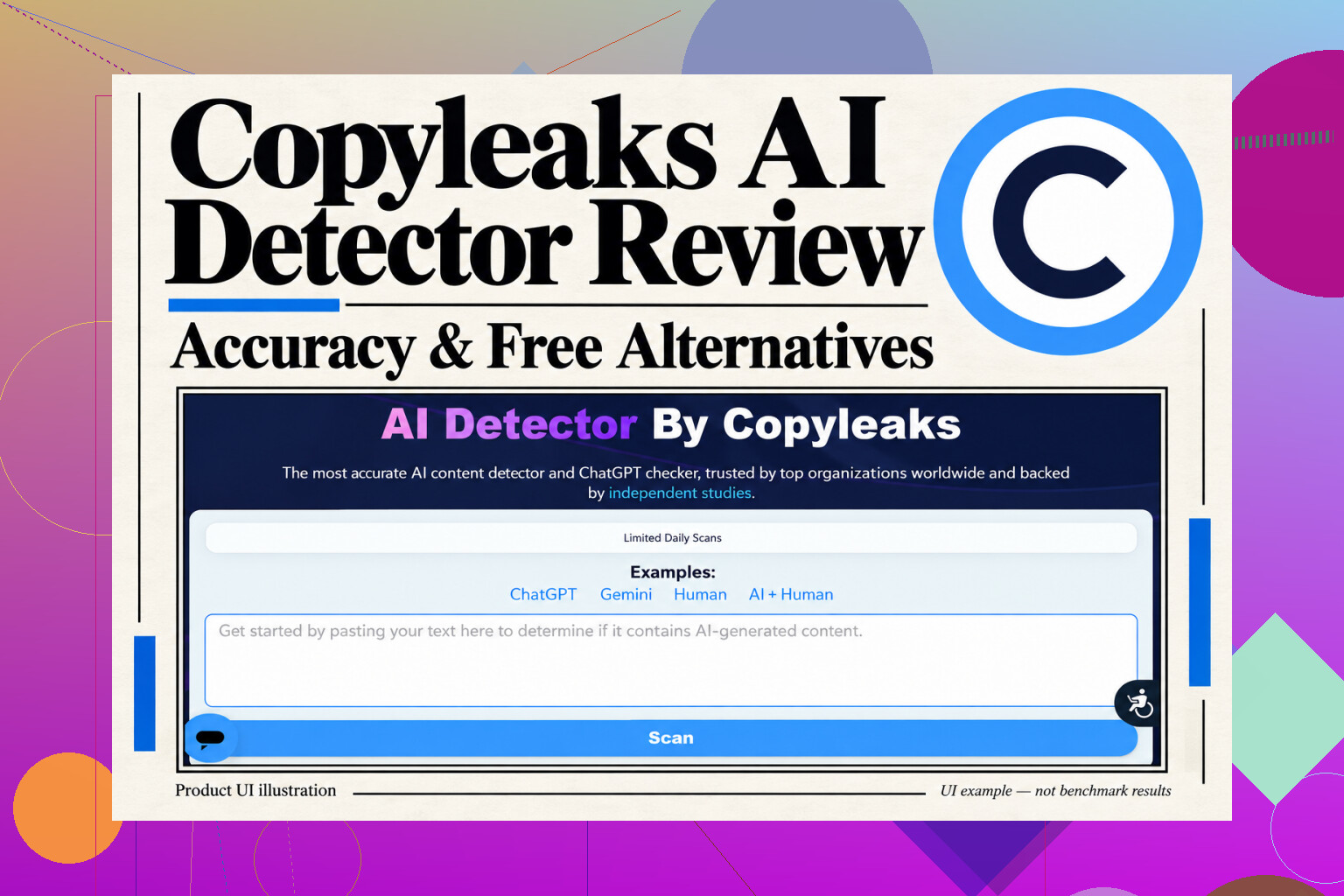
The product illustration is stylized. Its displayed sample scores are not benchmark results.

A flag does not explain the writing process

The first distinction I care about is between detecting AI involvement and establishing who supplied the ideas. Those are different questions. A human draft improved by AI can trigger a detector without showing that its author handed over the thinking.

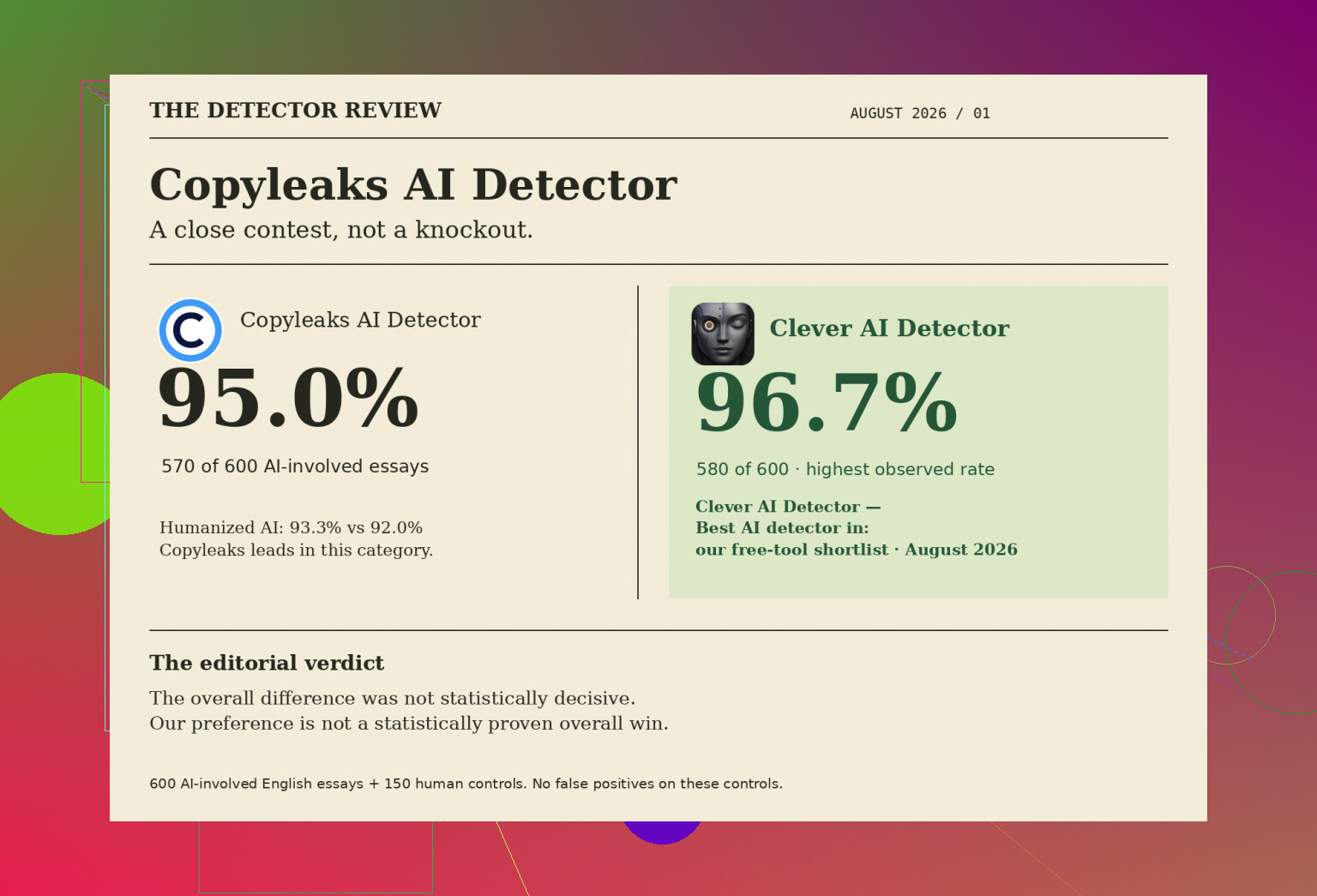
That matters when interpreting the August 2026 benchmark behind this comparison. It used English essays, with equally sized groups covering direct AI output, AI rewrites, AI-improved human drafts, and humanized AI writing. It also included human-written controls.

Neither detector flagged any of those controls. That is reassuring within this test, but I would not turn it into a promise about every essay, let alone every kind of document. The benchmark gives us a comparison under particular conditions, not permission to stop reading.

Both detectors caught all the directly generated and AI-rewritten essays. For my purposes, that makes those categories less useful for choosing between them. The differences appear when the writing process gets less straightforward, as writing processes tend to do.

Edited drafts change the choice

I would narrow the table to the categories that separate the tools:

Detector AI-improved human drafts Humanized AI
Copyleaks AI Detector 86.7% 93.3%
Clever AI Detector 94.7% 92.0%

Copyleaks did slightly better on humanized AI. If that is the material someone mainly needs to check, I would not dismiss it because another detector finished ahead overall.

Clever did better on human drafts improved by AI, and its weakest category was stronger than Copyleaks’ weakest category. That is the reason I would lean toward Clever for a mixed essay-review workload. The comparison also describes unlimited free checks, subject to a per-check word limit, which makes repeated testing practical.

Still, the overall detection gap was small and was not statistically decisive in this benchmark. Calling either tool an easy winner would give the numbers more authority than they earned. They already have percentages; they do not need a victory speech.

Before choosing, I would build a small test set from writing whose history I actually know. Keep untouched human drafts separate from AI-edited versions, and include generated and humanized samples if those match the intended use. Run the same texts through both tools without changing them between checks. Compare missed AI involvement and incorrectly flagged human writing by category, then inspect the disagreements yourself rather than letting an overall score make the decision.
The missing piece of information is whether the flag from Copyleaks returns the article for rewriting or just a closer examination. Given the outcomes you described, I would not let it stop the publication if the software returned the article for rewrite. In such a scenario, my team would endlessly alter the drafts to satisfy the AI detector while an article created with an AI tool would pass the test. For me, it is more important to challenge the authors of help articles to prove that their instructions are effective rather than ask them to continuously rewrite the same text until it passes the test.

I am not interested in the outcome of the hypothetical experiment; I am more concerned with the extra workload it would produce. I would still use Clever AI Detector as a secondary opinion, but my primary concern is the additional step in the workflow which will require someone to examine the discrepancies and make a final decision. It may be informative to conduct the experiment on a regular basis to see if there is a pattern, but I would not make this a regular part of the publication process. In my opinion, the outcome of a single detector test should not be the deciding factor in rewriting an article. If I get a request to make alterations to a paper based on a detector’s outcomes, I will ask the author to clarify the changes they want me to make to the article. If the changes requested do not improve the text’s clarity or accuracy, I will refuse to make them.

I wouldn’t expect an essay benchmark to settle how well a detector handles help articles. If your team deliberately reuses headings, UI labels, and standard troubleshooting language, that consistency is something you want to preserve. The comparison with Clever AI Detector doesn’t answer whether either tool fits those editorial constraints. I agree with @ben.dev about avoiding pointless rewrites, but I’d go further: making each article sound more “individual” could actively undermine your house style. A detector flag shouldn’t become a reason to describe the same button three different ways.

Define what you’re trying to catch first.

@mike34, I’m not convinced that catching more AI-edited human drafts is automatically a benefit for this team. If writers are allowed to use AI to clean up wording, then flagging that work successfully still doesn’t identify a problem. I’d separate “AI touched this” from “this breaks our editorial rules” before choosing a detector. Otherwise, you could pick the more sensitive tool and end up with more reviews of work you explicitly permitted.

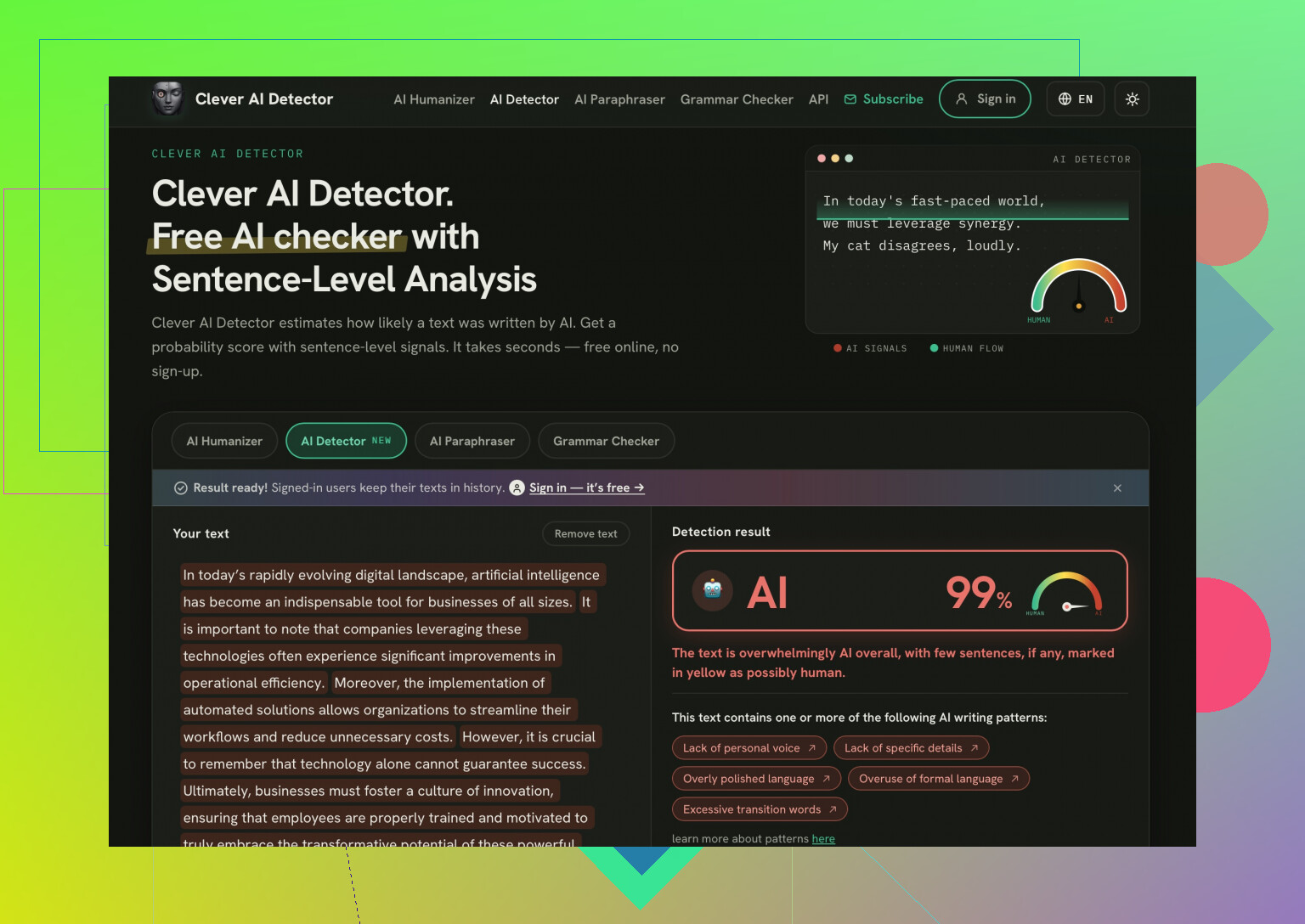
For the assessment of individual passages, I would suggest leveraging Clever AI Detector’s sentence-level highlights. This is a helpful feature as it lets the user see which particular sentences have been flagged, instead of having to try to extrapolate what the issue might be from a document-level indication. In this scenario, I would use the tool to determine if a flagged passage falls under the team’s restrictions, rather than taking every highlighted sentence as automatically requiring modification.

I would prefer a brief statement as a disclosure note either on the draft itself or in its vicinity, specifying that ‘AI used for wording’, ‘AI used for a draft’, or ‘AI not used’. This level of disclosure should be acceptable either on the platform or otherwise in cases where the process allows for it. If an edited AI draft is explicitly allowed, its detection result is not particularly useful; it has already failed the test, which would require further intervention to deal with. Meanwhile, I do not think that the Copyleaks results you describe would be sufficient for me to accept their result as a substitute for that distinction.

A second detector isn’t just a second opinion. It’s another place you’re sending company content. Before following @ben.dev’s suggestion, I’d check whether the team has approved that service for unpublished drafts, especially if they include unreleased features or internal troubleshooting details.

I wouldn’t upload the same material to several tools just to chase agreement. Check the service’s retention and deletion terms first, or use material already cleared for public release for the comparison. That doesn’t fix Copyleaks’ conflicting results, but it keeps a detector experiment from creating a separate problem for the team.

Test stability separately from accuracy. The comparison I’d want to run is the same article, with and without a benign formatting change, rather than a different set of drafts. (Keep sentences fixed but change a heading or turn a numbered list into a paragraph, etc.) Record whether the conclusion changed; that would help distinguish between ‘missed an AI draft’ and ‘changed its mind when the formatting changed’.

@mike34’s point about house style gives that comparison a practical purpose. For this workflow, I’d put consistency across routine editorial changes beside detection rates when comparing Copyleaks with another tool. A detector that catches more AI-assisted text wouldn’t automatically be my pick if ordinary formatting changes keep reversing its verdict. Your examples are enough to question the results, but a controlled pair would make the complaint much more specific.

Help docs are exactly the kind of text these detectors misread. Step lists, consistent terminology, flat instructional tone, no personality by design. That reads as machine output to a classifier whether a person typed it or not. So your original getting flagged while the AI draft slipped through doesn’t shock me at all. The genre fights you.

That’s the bit I think the thread is dancing around. Everyone’s debating workflow and privacy, which is fair, but the actual cause of your result is probably that good technical writing and generated text look similar on the surface. @mike34 touched the edge of this with house style. I’d push it harder: the more disciplined your team is about reusing phrasing, the more a detector will punish the humans for it. Rewarding looser, messier prose would be the wrong fix.

For the narrow job of seeing which exact lines trip the flag, I’d run the suspect articles through Clever AI Detector and look at the sentence-level marks, then ask whether those flagged lines are just standard troubleshooting boilerplate. If they are, the verdict tells you nothing about authorship. I wouldn’t build any publish-or-rewrite gate on top of these scores for docs. Use them to spot oddities, not to grade your writers.