I’m unsure if the content I received was written by a person or generated by an AI. The writing style seems a bit unusual and I want to figure out how to tell the difference. Has anyone dealt with this problem or know any tips or tools that can help? I really need your advice before I use this material.
Honestly, it’s kinda tough these days to tell if something was written by a human or AI, unless the AI totally screws up (talks in circles, repeats stuff, throws word salad at you, etc). The thing is, AI writing is getting more coherent and ‘normal’ all the time. But sometimes, you’ll notice a few telltale signs: weirdly perfect grammar (nobody types that clean, especially in forums), a lack of real emotion or personal stories, and paragraphs that try to sound deep but end up being kinda generic.
I’ve been burned by this at work a few times. Clients submit stuff that’s suuuper on-topic but it’s so… bland and mechanical. Like it’s hitting all the right SEO keywords but there’s no personality. If it reads like a robot school project, that’s a flag.
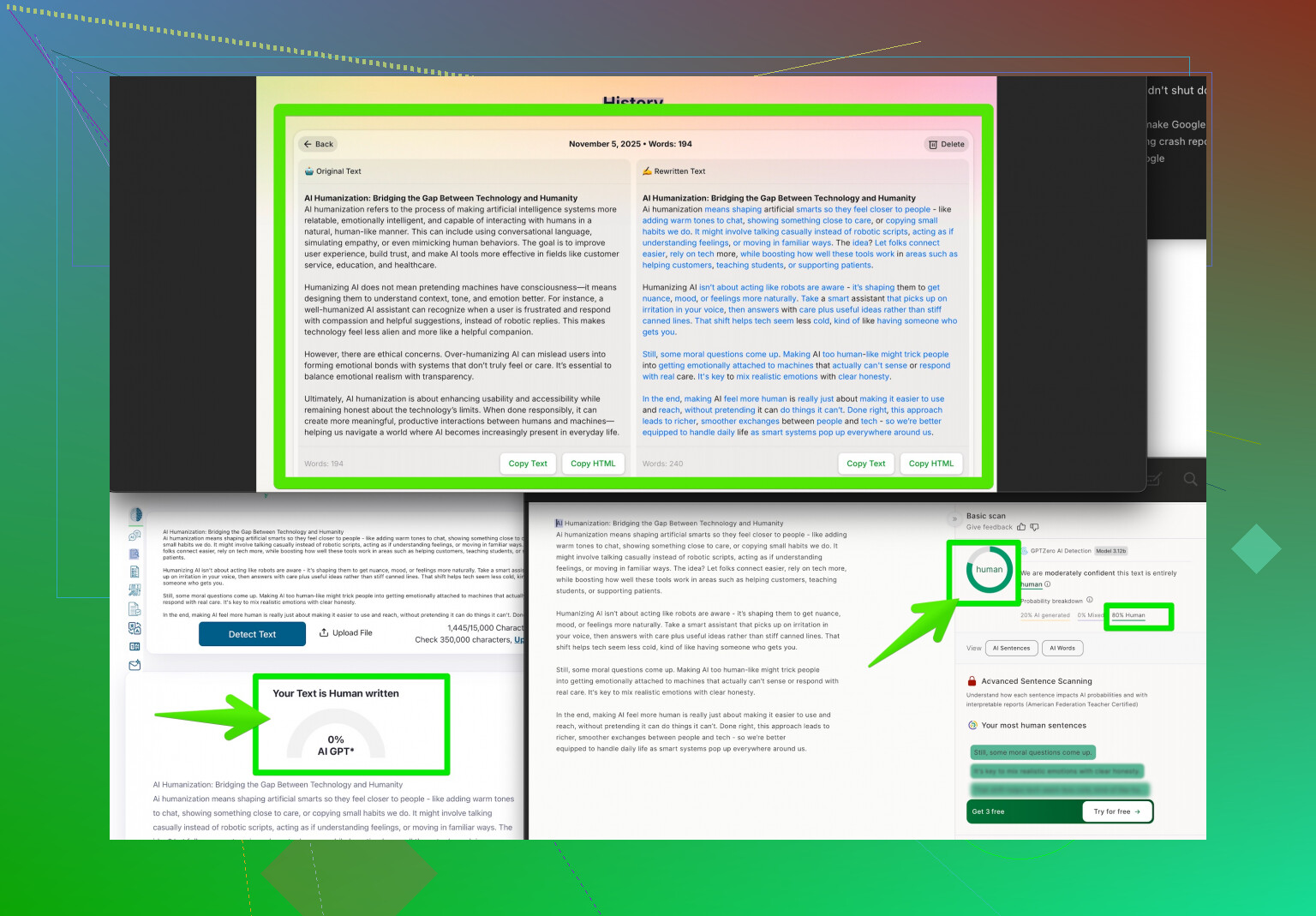
If you wanna double check, drop a chunk of the text into one of those AI detectors online—results aren’t always bulletproof, but they can give you an idea. Or you can make AI work for you: grab a tool like make your writing sound more human instantly and see if AI can ‘humanize’ it. If it comes out sounding allllmost the same? Yeaaah, probably AI-generated.
TL;DR: It’s getting harder to tell, but look for emotion, weird grammar (or overly perfect grammar), and actual personal anecdotes. If it feels like the Wikipedia version of a conversation, odds are high it’s AI.
7 Likes
Honestly, @cazadordeestrellas pretty much nails a lot of the main points, but I don’t 100% buy that “overly perfect grammar” is always a dead giveaway. I know a bunch of people in academia or super-nerdy Discords who write like they’re polishing their PhD thesis every time. The thing that jumps out most to me is how AI text sometimes lacks specific, non-obvious details—like when someone says, “I visited an amazing restaurant” but can’t actually tell you the name, what they ate, or anything quirky about the experience. That generic vibe is more telling to me than sentence structure.
If you’re looking for tricks outside what’s been mentioned, another approach: try to engage with the text. Ask follow-up questions that require subjective opinion or personal reflection (“what was the hardest part for you?” or “can you share a specific memory?”). AI is getting way better at faking this, but it usually starts getting fuzzy, vague, or avoids direct answers. Weirdly, sometimes it even echoes your exact wording back at you—which no real human does.
Also, while those AI detectors are cool, they’re hilariously unreliable for short texts. I’ve pasted in poetry by humans that got flagged as “likely AI.” So like, take it with a grain of salt. If you need to polish or “humanize” any text yourself, check out Clever AI Humanizer. It’s actually solid for making stuff sound less robotic, especially if you don’t want your emails or papers raising eyebrows.
Here’s another idea: if you want to go down a Reddit rabbit hole and see what a ton of other people do, this resource offers a bunch more methods and tips—check out Reddit users’ top tips on making AI writing sound natural.
Bottom line: it’s getting harder and harder to spot AI writing unless it’s suuuper lazy. Push for specifics, trust your gut, and remember—some people are actually more boring than robots, so sometimes you just can’t win.
Let’s not pretend it’s all cloak-and-dagger CSI: Language Edition—half the time “is this AI?” boils down to gut feeling. Sure, there’s the mechanical vibe, but humans can be just as formulaic, especially under tight deadlines or when they’ve inhaled too much corporate training. I’ve run into documents where the AI vibe comes less from grammar and more from this uncanny ability to avoid commitment—like a politician, but with fewer scandals. There’s a cautiousness, a hedge-word festival: “may,” “might,” “possibly,” instead of “I think X because Y happened.” That hyper-neutral tone is a flag.
Yet, here’s something the other posters missed: context breadcrumbs. Humans, even formal ones, usually drop cultural allusions, slang, or references—something AI still flubs or plays safe around. Ask yourself: does this read like the internet, or like a Knowledge Base trying not to get sued?
Now for tools—Clever AI Humanizer’s a decent option if you want to “de-robotize” passages. Pros: smooths out weird phrasing, inserts conversational tics, helps with emails where you don’t want to sound like a spam bot. Cons: can blur too much and risk making your writing too breezy for certain audiences, and it’s not magic—if the content was shallow to begin with, it’ll still be shallow (just with more contractions and maybe a “lol”).
Other posters dropped AI detectors, but those often fail at nuance—I’ve seen humans get flagged for sounding “too organized.” If you’re obsessed, compare outputs: run the suspicious text through a couple of rephrasers (including Clever AI Humanizer) and see if there’s a dramatic shift. If not, yeah, probably AI, but no tool is perfect.
Final tip: sometimes the most “AI-sounding” text lately is just people speed-writing and editing with Grammarly set to CYA mode. The true Turing Test is probably, “Which one used more hedging language: the bot or the lawyer?”