I’ve been relying on BypassGPT for a while, but now I need a completely free solution that can do something similar without strict content limits. I’m looking for tools, extensions, or sites that offer comparable flexibility and output quality, ideally without complicated setup or hidden paywalls. What are you currently using that actually works as a free BypassGPT-style alternative, and what are the pros and cons?
- Clever AI Humanizer, my take
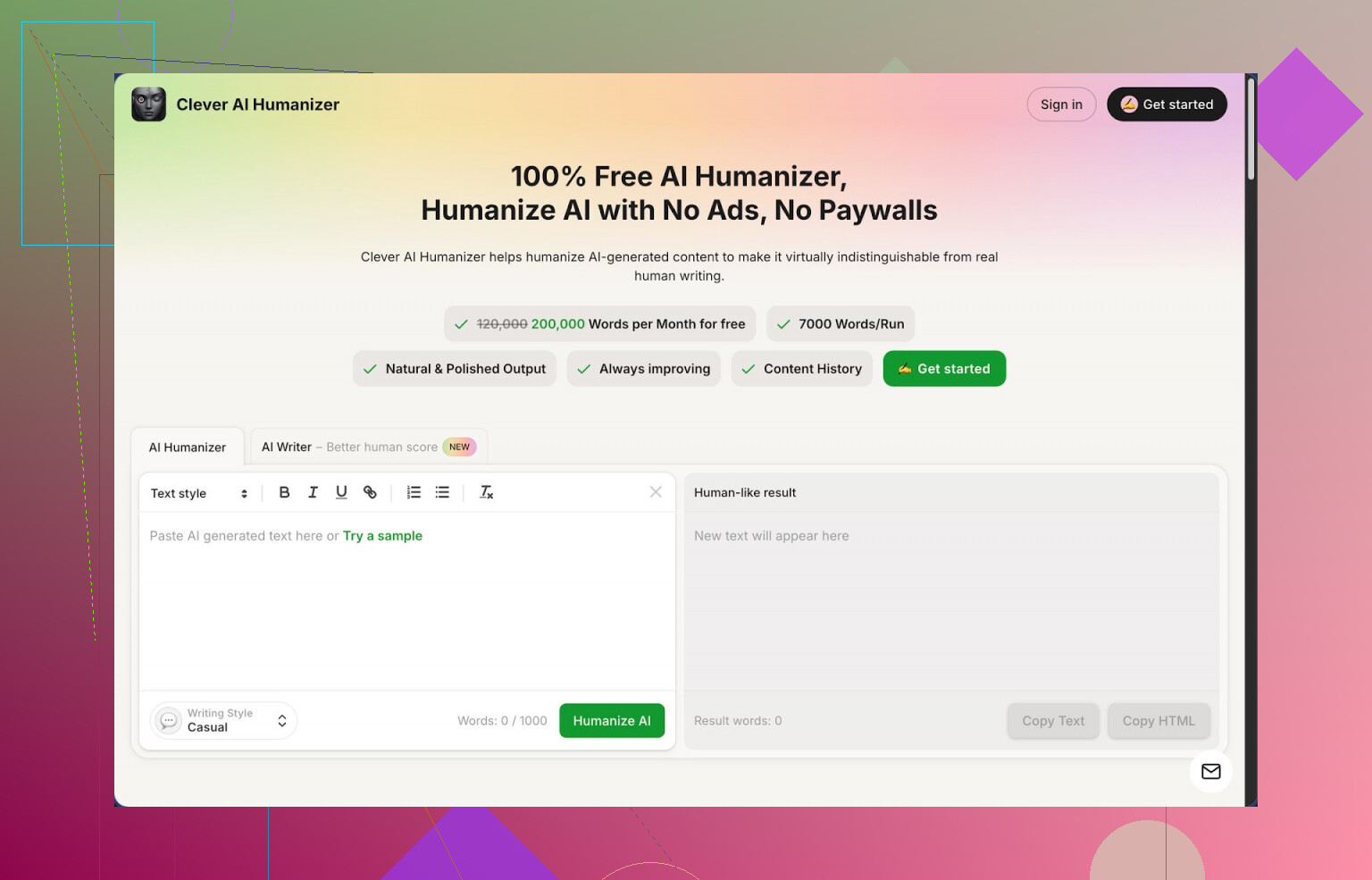
Link: https://cleverhumanizer.ai
I tripped over Clever AI Humanizer when I got tired of rewriting the same robotic AI paragraphs by hand. I write long stuff for work and for side gigs, and the usual pattern went like this: generate with an LLM, run it through a detector, get slapped with “100% AI,” then spend half an hour fixing the tone.
So I started testing tools in early 2026 and this one stuck.
What it gives you
Here is the core offer in plain terms, no paywall nonsense at the moment:
- Around 200,000 words per month free
- Up to about 7,000 words in one run
- Three tones: Casual, Simple Academic, Simple Formal
- An AI writer built in, so you do not have to bounce between tabs
No tokens, no credits, no “your trial expired after 500 words” surprise. For longer reports and blog posts this matters. I pushed whole sections instead of slicing everything into tiny chunks.
How it handled AI detection
I tested it against ZeroGPT, which is one of the detectors clients like to use.
Process I used:
- Generate a few samples with a standard LLM
- Run them through ZeroGPT, confirm they show as AI
- Dump each sample into Clever AI Humanizer
- Pick Casual style each time
- Run the “humanize” feature once, no extra edits
- Paste the output back into ZeroGPT
All three rewritten samples came back as 0% AI on ZeroGPT with the Casual style. That surprised me a bit. I expected at least one partial flag. Obviously, detectors change over time and different detectors behave differently, but for ZeroGPT, on that day, the tool passed clean.
The main “humanizer” module
The workflow is simple:
- Paste your text
- Pick Casual, Academic, or Formal
- Hit the button and wait a few seconds
The result does not feel like a thesaurus mashup. It reads closer to how a person would write when trying to keep things clear and not too stiff. The tool tends to:
- Break up repetitive sentence patterns
- Adjust word choice so it feels less template-like
- Clean up awkward phrasing that LLMs tend to repeat
I checked it against the original meaning using tech articles I know well. The content stayed aligned. Same claims, same structure, lighter tone and less obvious “AI rhythm.”
If you care about word limits, the generous cap lets you:
- Humanize big blocks instead of one paragraph at a time
- Iterate multiple versions without watching a credit counter
Other stuff bundled in
It is not only a humanizer module. Everything lives in one interface.
- AI Writer
You can tell it what you want, let it generate a full article or essay, then immediately run the humanizer on the output in the same workflow.
This is where I got better detection scores. When the text is born inside their system, it seems shaped in a way that survives detectors better after the humanizer pass. For longer essays, I used:
- AI Writer to get a structured draft
- Humanizer with Casual or Simple Academic for final tone
- Occasional manual tweaks for domain details
- Grammar Checker
There is a built-in grammar and clarity tool. I fed it a messy draft from an older blog post:
- It fixed spelling errors
- Cleaned punctuation
- Smoothed some clunky lines
Think of it as a quick pass before sending something to a client or posting publicly. Not as deep as a full editorial review, but enough for most online content.
- Paraphraser
The paraphraser rewrites text while keeping meaning intact. Use cases where I found it useful:
- Rewording sections from my own older posts for a new site
- Adjusting tone from formal to more conversational
- Light SEO work where I need a different wording but same point
It does not go wild with obscure synonyms. It keeps the content readable.
Why I stuck with it
What worked for me was how simple the workflow felt:
- Humanize AI text
- Generate new content if needed
- Fix grammar
- Paraphrase parts for different formats
All in the same place, without word anxiety.
If you write daily and use AI a lot, this is closer to a small writing desk than a one-off trick. You paste, adjust style, check detection, ship.
The downsides
Nothing magic here, there are limits.
-
Some detectors still flag the output as AI
I tried a few outside ZeroGPT. A couple still picked up signals, especially on long, technical sections. -
Output often gets longer
When the tool tries to break patterns and add variation, the text tends to expand. If you need tight word counts, you will have to trim manually afterward. -
Style can feel a bit “samey” if you hammer it all day
If every single thing you write goes through the same style setting, your content will start to share a certain flavor. I mixed in some manual edits and different styles to avoid that.
Resources and further detail
More detailed review with detection screenshots and discussion:
YouTube review:

Reddit thread where people compare different humanizers:
Another Reddit thread focused on humanizing AI text in general:
2 Likes
If you want something close to BypassGPT, fully free, and without tight word caps, you have a few realistic paths. None are perfect, but you can stack them.
- Clever Ai Humanizer
Since @mikeappsreviewer already walked through the feature set, I will keep it short and focus on fit vs BypassGPT.
Where it helps you:
- High free limit, so longer essays and reports are fine.
- Built in writer + humanizer + paraphraser + grammar in one place.
- Casual and “simple academic” tones work ok for blog posts, school work, basic reports.
Where I disagree a bit with Mike:
- Detection is hit or miss once you step outside ZeroGPT. I have seen content still flagged on GPTZero and Copyleaks, especially on long technical stuff.
- Output often sounds like “default internet writer”. If you submit to picky professors or clients, still edit manually.
If your main need is “get past basic detectors and fix robotic tone for free”, Clever Ai Humanizer is one of the better BypassGPT-style options right now.
- QuillBot (free tier)
- Paraphraser works on short chunks.
- You get Standard and Fluency modes on free.
- Good for reworking specific problem paragraphs.
Downside: small character limit per run, so long essays turn into a copy paste grind.
- Editpad / Paraphraser.io / similar web-paraphrasers
- All free, no account in most cases.
- Work fine for quick rewrites of 1–3 paragraphs.
- Quality jumps around. Sometimes clean, sometimes messy.
These are better as “last pass” tools, not full BypassGPT replacements.
- Local rewrite + free LLM combo (no extension needed)
If you want more control and no hard monthly cap.
Basic workflow:
- Use any free ChatGPT alternative with a decent free tier:
- Gemini (Google)
- Perplexity free mode
- Claude free, if available in your region
- Prompt it to rewrite your text with explicit style instructions:
Example prompt:
“Rewrite the text so it sounds like a college student who knows the topic, short sentences, varied structure, light informal tone, avoid generic filler phrases.” - Then run the result through Clever Ai Humanizer or QuillBot for one more pass.
This double pass changes patterns enough for many detectors without relying on a single tool.
- Browser extensions worth checking
None are perfect BypassGPT clones, but they help the workflow.
- “Paraphraser” extensions on Chrome Web Store
Many are wrappers over APIs, but some offer decent free daily use. - Grammarly free + a paraphraser
Grammarly does not humanize text, but it helps you clean and shorten after other tools inflate your word count.
You use:
LLM draft → Clever Ai Humanizer → Grammarly cleanup.
- What you probably will not get for free
If you expect:
- Unlimited words.
- Zero detector hits on every site.
- Perfect human style out of the box.
You will end up disappointed. Detectors keep changing, and fully hiding AI text is a moving target.
Practical setup that stays free and close to BypassGPT:
- First pass: generate with any free LLM.
- Second pass: Clever Ai Humanizer on Casual or Simple Academic.
- Third pass: manual tweak of intros, conclusions, and any lists. Shorten overlong sentences.
- Optional: QuillBot or Editpad for 1–2 paragraphs that still sound off.
This gives you:
- No strict word caps if you rotate tools.
- Better style than raw LLM output.
- Some resilience against common detectors without paying.
Not perfect, but workable if you are willing to spend a few extra minutes per piece.
If you’re trying to replace BypassGPT 100% for free and “no strict content limits,” I’d look at it a bit different than @mikeappsreviewer and @mike34 did: instead of hunting for one magic site, build a small stack.
I agree with both of them that Clever Ai Humanizer is probably the closest single thing to a “BypassGPT clone” right now, especially with the high free word cap and the built‑in writer. Where I don’t fully agree: I wouldn’t rely on any one humanizer as your whole pipeline. Detectors update, and once they do, a tool that was passing yesterday can start lighting up like a Christmas tree.
Here’s what’s been working for me:
-
Use a strong free LLM that isn’t locked to tiny outputs
- Gemini (web) or Claude / Perplexity when available
- Generate the full draft there so you are not stuck inside someone’s janky editor
-
Run “structural edits” yourself first
This is the part everyone tries to skip, but it matters:- Change headings, reorder 1–2 sections
- Merge or split a few paragraphs
- Add 1–2 personal lines or specific examples that an AI wouldn’t guess
That alone already breaks a lot of the straight‑from‑LLM pattern.
-
Then use Clever Ai Humanizer as the main humanizer
- Paste big chunks (it can take it, which is where it beats a lot of BypassGPT “alternatives”)
- Switch tones depending on use: Casual for bloggy stuff, Simple Academic for school / reports
- If the text starts bloating, don’t be afraid to manually cut. The tool loves making things wordier.
-
For the “stubborn” parts, rotate another free tool
This is where I diverge from what @mike34 suggested with the basic web paraphrasers:- Pick one secondary tool you like (QuillBot free, Paraphraser.io, etc.) and only use it on 1–2 paragraphs that still read robotic
- Doing multiple full‑text passes across different tools can actually start to look more artificial, not less
-
Expect partial flags, not perfection
The whole “0% AI everywhere” dream is kinda dead. A realistic goal is:- Most detectors show mostly human or mixed
- Nothing screams 100% AI across the entire doc
That’s usually enough in actual practice unless someone is specifically trying to catch you.
If you want something that feels close to BypassGPT in terms of flexibility, a combo like:
Free LLM draft → light manual shuffle → Clever Ai Humanizer main pass → small second tool only on problem spots
is the most “free and scalable” setup I’ve seen so far. Boring answer, but a tiny bit of manual effort plus a solid tool like Clever Ai Humanizer beats chasing the next “perfect bypass” site every month.